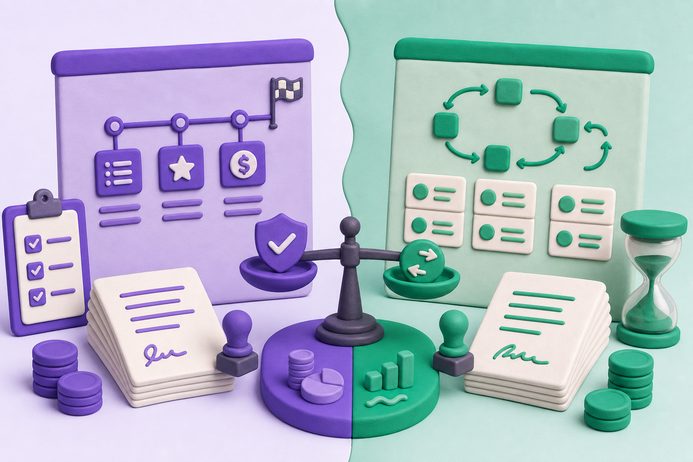
Fixed-price MVP contracts provide more budget predictability, while time-and-materials contracts provide more flexibility as the product changes. Choose between them based on scope certainty, technical risk, budget limits, and your team’s ability to manage delivery.
How Much Does It Cost to Build an MVP in 2026? A Realistic Breakdown goes deeper on the ideas above and adds concrete next steps.
How do I decide between fixed-price and time-and-materials?
Match the contract to how much uncertainty remains in your MVP.
- Stable scope and known integrations: Consider fixed price.
- Unproven workflows, AI behavior, or architecture: Use paid discovery or time and materials.
- Mixed certainty: Use discovery first, then a fixed-price or capped build.
- Limited internal capacity: Add a budget cap, weekly decisions, and clear vendor reporting.
This workflow is directional, not a guarantee. Its value is making assumptions visible before they become change requests, delays, or excess spend. The business impact is a better match between the contract and the learning your MVP still requires.
When you move from outline to execution, MVP vs. Prototype vs. Pilot: What's the Difference, and Which Do You Need helps close common gaps teams hit here.
When should I use fixed-price versus time-and-materials?
Choose fixed price when user journeys and acceptance criteria are stable; choose time and materials when discovery may change the product.
The practical difference
A fixed-price MVP has an agreed scope, delivery window, and fee. Work outside that baseline usually requires a documented change that may increase cost or extend the timeline.
Time and materials means paying for actual engineering time and expenses. Delivery typically follows a prioritized backlog, regular demos, and ongoing product decisions.
Fixed price improves predictability, while time and materials improves adaptability. Neither model removes delivery risk.
What each model optimizes for
Fixed price
- Higher cost certainty
- Lower tolerance for discovery
- Formal changes that may add cost or time
- Best for defined journeys, integrations, and launch criteria
Time and materials
- Higher scope flexibility
- Lower cost certainty unless capped
- More responsibility for prioritization
- Best for evolving products and technical uncertainty
A low fixed-price quote is not automatically cheaper. It may exclude QA, deployment, security, monitoring, or post-launch fixes. Time and materials can also become expensive when decisions are slow or the backlog keeps expanding.
A complementary angle worth comparing lives in 8 Questions to Ask Before Hiring an MVP Development Agency.
What steps should I follow to choose the right MVP pricing model?

A left-to-right decision flow that starts with scope certainty, then checks AI, automation, integration, and architecture risk, followed by budget and deadline constraints. The flow ends in fixed price, time and materials, or a hybrid of paid discovery followed by capped iterative delivery.
Choose the model by assessing scope certainty, technical risk, budget limits, and your team’s ability to manage the work.
Step 1: Define scope certainty
List launch-critical user journeys before requesting a fixed-price estimate.
List the essential journeys
Include signup, payments, dashboards, admin workflows, notifications, integrations, and AI-assisted actions. Separate launch needs from later enhancements.
Define “done”
Document acceptance criteria, supported devices, user roles, integrations, performance expectations, security needs, and approval evidence.
Rate your certainty
Fixed price is safer when these details are known. Time and materials is safer when research, stakeholder decisions, or technical discovery may change them.
“Users upload documents and receive a summary” is not enough for a fixed quote. Clarify file types, size limits, processing time, model behavior, failure handling, and human review.
Step 2: Match the contract to technical risk
Use paid discovery or time and materials when important technical assumptions remain untested.
Check AI model performance, API limits, data migration, security requirements, automation reliability, and architecture decisions. Effort can vary with data quality, evaluation criteria, integrations, team capability, and testing depth.
A technical spike can test one risky assumption before a larger build. Then review the findings, budget, and deadline constraints before choosing fixed price, time and materials, or a hybrid.
Step 3: Compare proposals beyond price
Choose the proposal that best matches product risk, not automatically the lowest quote or hourly rate.
Ask for:
- Schedule, team roles, milestones, and dependencies
- Testing, deployment, security, and support responsibilities
- Assumptions, exclusions, and change-request rates
- Repository, cloud account, source-code, and IP access
- Demo cadence, approval process, and budget reporting
Good documentation and handover can reduce vendor dependence, but only if your team receives access and has enough capability to operate the system.
For tradeoffs, checklists, and edge cases, What Should an MVP Handover Actually Include? rounds out this section.
Contract mistakes that make MVP costs unpredictable
Most MVP cost problems come from unclear scope and weak delivery governance, not from the contract label alone.
Fixed-price agreement mistakes
A fixed-price agreement becomes unreliable when the scope is broad but acceptance is vague.
Common failures include:
- “Build an MVP” without defined journeys, platforms, integrations, or launch criteria
- Estimates that omit QA, deployment, observability, security, or support
- No written assumptions or exclusions
- No process for evaluating scope changes
- Milestones approved without working software or acceptance evidence
Prevent these issues with a scope baseline, explicit assumptions, milestone sign-offs, and written change control. Each change should state its cost, schedule impact, and whether it replaces existing scope.
A quote may cover development but exclude deployment and production monitoring. The product can then appear complete while still needing unplanned spending before launch.
Time-and-materials delivery mistakes
Time and materials becomes uncontrolled spending when no one actively manages priorities, burn, or decisions.
Use a practical operating rhythm:
- Weekly: Demo working software, review blockers, and update the decision log.
- Every one to two weeks: Re-rank the backlog against one product goal.
- Monthly: Review hours used, remaining budget, forecast, and release priorities.
- At major decisions: Confirm the tradeoff, owner, deadline, and expected evidence.
- Throughout delivery: Require release notes, acceptance evidence, and vendor reporting.
Set a monthly cap or approval threshold. Expect more client time during discovery, approvals, and launch preparation. If approvals stall, the project can exceed its cap or schedule even when the team is working efficiently.
MVP contract checklist and recommendation
The safest MVP contract makes scope, risk, spending, ownership, and handover visible before development begins.
Before approving a proposal, confirm:
- Scope: User journeys, acceptance criteria, platforms, integrations, exclusions, and assumptions
- Commercial terms: Rates or total price, change process, budget cap, payment milestones, and escalation rules
- Delivery quality: Testing, deployment, monitoring, demos, release notes, and defect handling
- Ownership: Repository, source code, IP, cloud accounts, infrastructure, and third-party accounts
- Handover: Operational documentation, deployment instructions, support period, and first metrics review
Use fixed price for genuinely stable scope, time and materials for active discovery, and a hybrid when discovery can remove major uncertainty. Reassess the model if testing changes the product or exposes new integration work.