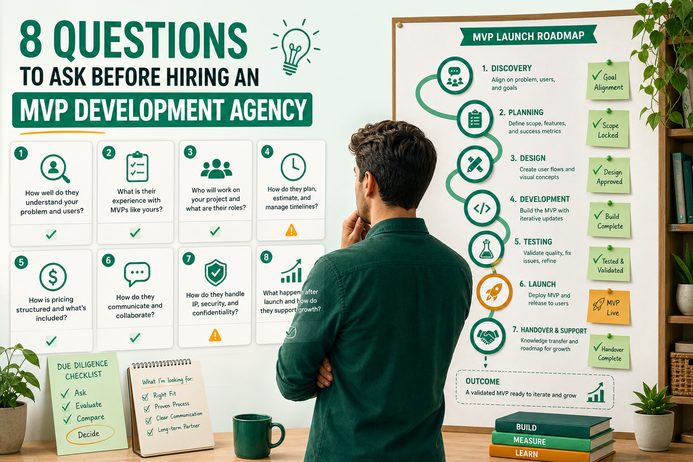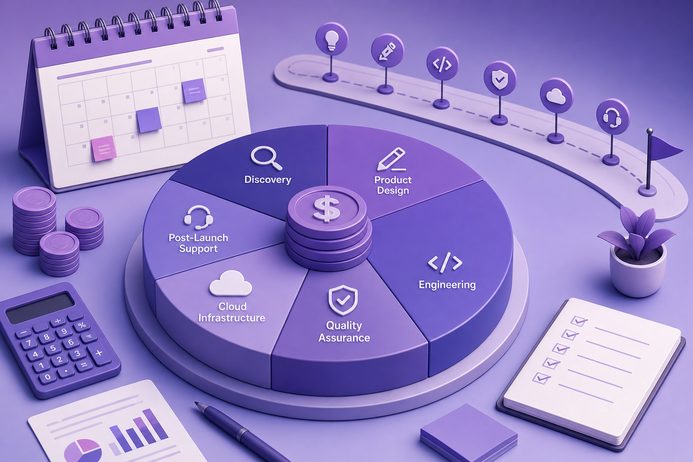

The hardest part of an MVP handover is proving that the startup team can deploy, monitor, troubleshoot, and extend the product without waiting for the original builder.
8 Questions to Ask Before Hiring an MVP Development Agency goes deeper on the ideas above and adds concrete next steps.
What does an MVP handover need to prove before the builder steps away?
An MVP handover is complete when the receiving team can perform a normal release and respond to a plausible failure without step-by-step builder intervention. That includes making a safe change, deploying it, checking system health, and following a rollback or recovery path where one exists.
The standard depends on product complexity and team capacity. A simple web MVP may need a focused review, while a mobile or AI-enabled product with multiple vendors can require several days of access checks, documentation, and rehearsal.
When you move from outline to execution, What a Fractional CTO Actually Does in the First 30 Days helps close common gaps teams hit here.
How do you demonstrate early proof of readiness?
A useful readiness test is whether the product remains builder-dependent or is controlled by the startup.
Before verification, access may sit in personal accounts, deployment may be manual, incidents may be found through ad hoc messages, and technical priorities may exist only in the builder's memory.
After verification, the startup has named account owners, documented release steps, tested monitoring, known recovery options, and a prioritized list of remaining risks.
This is a directional benchmark, not a universal industry metric. Its practical impact is fewer clarification loops, lower release risk, and better decisions about whether technical support is needed.
A complementary angle worth comparing lives in MVP vs. Prototype vs. Pilot: What's the Difference, and Which Do You Need.
What technical and operational assets must a handover include?

A process diagram flowing from builder-held MVP assets to startup-controlled operations: repositories and architecture, cloud and app-store accounts, secrets and MFA, CI/CD and rollback, monitoring and incident response, then named owners and recurring costs.
A complete handover combines code, access, deployment knowledge, security controls, product context, operating costs, and known limitations.
Package the product so another engineer can change it safely
The receiving team needs enough context to make the next change, not merely enough files to run the current version.
Include:
- Repository ownership, branch conventions, release process, and dependency versions
- Environment variables, local setup, database schema, migrations, and backup assumptions
- Architecture notes covering services, data flows, jobs, and queues
- Critical user flows, feature flags, analytics events, and integrations
- Web or mobile build and publishing instructions
- Known technical debt, fragile areas, and decisions that affect future work
A short, specific architecture note is more useful than generic documentation. Highlight where a new engineer should be cautious and which assumptions remain unproven.
Transfer access and security ownership explicitly
The startup should control critical systems through organization-owned accounts rather than a contractor's personal login or a shared credential.
Confirm ownership for:
- Git hosting, cloud infrastructure, CI/CD, and databases
- App Store Connect or Google Play Console
- Domains, email, analytics, crash reporting, and payments
- AI providers, API vendors, monitoring, and support tools
Move secrets into the startup's password manager or secrets manager. Enable MFA where available, rotate credentials as appropriate, remove unnecessary access, and document production approval responsibilities.
Document deployment, rollback, backup, restore, production access, and incident escalation. Manual publishing can be reasonable for an early MVP, but it remains an operating risk.
Record limitations and recurring costs
The handover should show what the product costs to run and which shortcuts may become expensive later.
Document:
- Hosting, database, monitoring, SaaS, AI, API, and support costs
- Billing owners, renewal dates, usage limits, and spending alerts
- Manual processes and integrations that could fail
- Missing tests, scalability thresholds, and compliance gaps
- Work outside the current scope
Treat an item as a launch blocker when it creates material security exposure, threatens data recovery, affects a critical revenue path without a fallback, or has no owner. A limitation can be acceptable for an MVP when its impact is contained, documented, assigned, and unlikely to prevent recovery or normal operation.
For tradeoffs, checklists, and edge cases, Technical Due Diligence: What Investors Actually Check at Pre-Seed and Seed rounds out this section.
How should a startup verify an MVP handover before accepting it?
The safest approach is a staged rehearsal in which the startup performs key workflows while the builder observes and corrects gaps.
Run a builder-led walkthrough
Review the repository, environments, deployment process, monitoring, support workflow, recovery options, and open risks. Record unanswered questions and missing evidence.
Run a startup-led rehearsal
The designated owner repeats a staging deployment, a production-safe release or simulation, a failed-deployment response, and a rollback or restore exercise where supported. The builder observes without taking control.
For a straightforward product, allow roughly half a day for an access audit and one working day for rehearsal and remediation planning. More complex products, multiple platforms, regulated data, or weak documentation can require several days or a targeted remediation sprint.
Finish with a written gap list containing the issue, severity, owner, evidence required, and target date. Verbal assurances are not an acceptance process.
Use acceptance criteria that expose single-person dependency

A mobile-friendly checklist for the receiving team to confirm repository setup, staging deployment, production release or simulation, monitoring and logs, rollback, backup or restore evidence, credential rotation, owner assignment, recurring costs, and unresolved high-risk items.
The handover is ready when a designated team member can:
- Configure a safe environment and run available checks
- Explain the main architecture and critical user flows
- Identify production errors through logs or crash reporting
- Locate the responsible service and follow escalation steps
- Complete a routine release through a documented workflow
Measure readiness through completed rehearsal steps, named owners, unresolved high-risk items, and the time required for a normal release. A sound product can still have an incomplete operating process.
How Much Does It Cost to Build an MVP in 2026? A Realistic Breakdown reframes the same problem with a slightly different lens - useful before you finalize.
What mistakes leave an MVP handover incomplete?
Most incomplete handovers result from undocumented decisions, shared credentials, untested release paths, and unclear post-launch responsibility rather than missing source code.
Watch for these patterns:
- Documentation after the fact: Notes that omit setup, deployment, failure handling, or limitations are not operational documentation.
- Credentials in a contractor's account: Use organization-owned accounts and a documented offboarding process.
- Demo equals acceptance: A demonstration proves the builder can operate the product. Acceptance requires the startup team to perform key workflows.
- No named post-launch owner: Someone must own incidents, renewals, production decisions, and technical priorities, even if initially part-time.
MVP handover pre-flight checklist
Before final sign-off, verify that:
- Repository, cloud, app-store, vendor, billing, analytics, monitoring, and domain ownership use startup-controlled accounts
- Staging deployment and production release or simulation are documented and rehearsed
- Monitoring, logs, rollback, backup, and restore evidence are available where supported
- Credentials have been reviewed, rotated where appropriate, and unnecessary access removed
- Every major system has a named owner and escalation path
- Recurring costs, renewal dates, usage limits, and billing owners are recorded
- Known limitations and the next three technical priorities are documented
- High-risk unresolved items have an owner and target date
The next step may be a documentation fix, targeted remediation sprint, or ongoing technical support. It should not automatically be a large rebuild.