
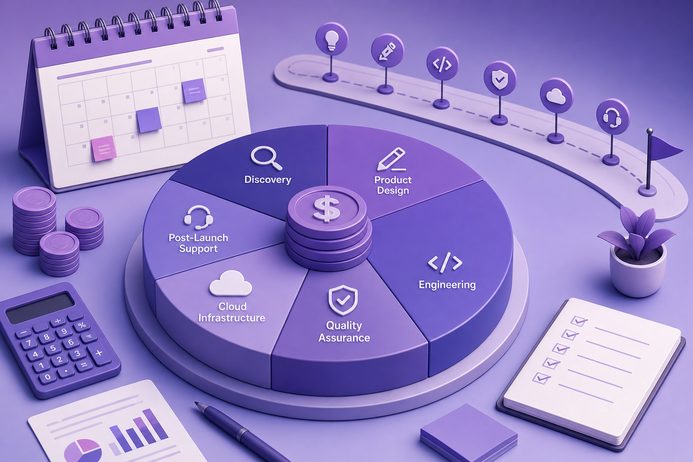
A realistic 2026 MVP budget is usually $15,000-$180,000, depending on scope, platforms, integrations, risk, and launch requirements. The better question is what must be built to produce trustworthy customer evidence, and this guide provides directional ranges, cost drivers, effort assumptions, and an approval checklist.
Early proof
- $15,000-$40,000: One user type, one platform, and one core workflow.
- $40,000-$90,000: A stronger release with authentication, analytics, payments, administration, QA, and production deployment.
- $90,000-$180,000: AI-heavy, regulated, multi-platform, or integration-intensive products.
These are illustrative planning ranges, not fixed market statistics. A $30,000 responsive web prototype may cover authentication and one workflow, while a $75,000 pilot-ready release may also require payments, permissions, monitoring, third-party APIs, and stabilization.
The business impact is direct: reducing scope can protect the learning goal, but removing QA, security, or operational ownership can delay pilots and create rework.
MVP vs. Prototype vs. Pilot: What's the Difference, and Which Do You Need goes deeper on the ideas above and adds concrete next steps.
How much does an MVP typically cost in 2026?
Budget an MVP by product tier and business outcome rather than by the label "MVP." Costs rise when the product handles sensitive data, requires native apps, depends on unproven integrations, or has a compressed launch date.
Use these directional planning assumptions:
- 15%-25% contingency: A reasonable starting reserve when requirements are partly known. Keep more for regulatory review, uncertain integrations, or unresolved technical risks.
- 4-8 week validation window: Possible for a narrow product, but customer recruitment, compliance, integrations, and approval cycles can extend it.
- Separate ownership: Identify who handles product decisions, design, engineering, QA, infrastructure, support, and handover.
The first budget should fund a launchable learning loop, not a small version of the future platform. Actual cost and timing depend on scope, team capability, customer access, integrations, and decision-making speed.
When you move from outline to execution, Web App or Mobile App? The Real Tradeoffs Founders Face in 2026 helps close common gaps teams hit here.
What are the main cost drivers for a 2026 MVP?
The largest cost increases usually come from additional roles, platforms, integrations, compliance requirements, and uncertain AI behavior. Each requested feature should connect to a customer metric, business decision, or launch dependency.
Key drivers include:
- Discovery: Interviews, workflow mapping, acceptance criteria, and prioritization may take several focused days to two weeks when requirements are unclear.
- Design and engineering: Frontend, backend, QA, DevOps, technical leadership, and project management all require time. Missing ownership often creates rework.
- Platforms: Web, iOS, and Android add separate testing, deployment, and support work.
- Complexity: Payments, permissions, real-time behavior, imports, external APIs, and analytics increase failure-path effort.
- Launch operations: Backups, monitoring, security fixes, support, and documentation continue after release.
Use this estimation process:
Count core workflows
Define the workflows needed for the first customer outcome, not every feature in the long-term product brief.
Score workflow complexity
Review screens, roles, data states, integrations, failure paths, and acceptance tests.
Add delivery and operating work
Estimate discovery, design, engineering, QA, infrastructure, monitoring, support, and handover separately.
Protect the validation date
Move nonessential requirements to a later release before compressing testing, security checks, or documentation.
A complementary angle worth comparing lives in What are the startup trends for 2026 and how to apply 80/20 rule.
How do AI features affect MVP cost and ongoing operations?
AI increases MVP cost when the product must prove quality, protect data, and manage uncertain outputs in real usage. API fees are only one part of the budget.
A credible AI plan includes:
- Model and prompt selection
- Evaluation data and quality thresholds
- Retrieval or tool integrations
- Human escalation for uncertain outputs
- Privacy, logging, and usage-cost controls
- Ongoing review of failures and edge cases
A narrow AI workflow may need several days of evaluation; varied inputs or high-risk decisions can require several weeks. Measure task completion, grounded-answer rate, review time saved, escalation rate, or cost per successful workflow.
After launch, a support or operations owner may need roughly 1-3 hours per week to review failures, monitor usage and costs, handle escalations, and update prompts or test cases. That burden can rise with user volume, model changes, or stricter quality requirements.
An API-powered proof of value is often practical, but it still needs monitoring and review after launch.
For tradeoffs, checklists, and edge cases, 8 Questions to Ask Before Hiring an MVP Development Agency rounds out this section.
A low-cost MVP works when it removes scope, not responsibility
A low-cost MVP is sensible when it narrows users, platforms, and workflows. It becomes risky when it removes security, observability, testing, backups, or the ability to learn from real users.
A $15,000 MVP may be realistic for one user type, one responsive web platform, and one core workflow using managed services. Manual operations can reduce build cost, but someone must perform and budget for that work.
Be cautious with very low fixed-price proposals covering web, iOS, Android, administration, AI, and multiple integrations. The risk is not the price alone; it is whether requirements, QA, architecture, and documentation are defined well enough to prevent rework.
Before signing, require:
- Prioritized scope and written exclusions
- A workflow map or clickable prototype
- Architecture recommendations and technical risks
- Milestones, assumptions, and acceptance criteria
- QA, monitoring, support, and stabilization plans
- Repository, cloud account, credential, and documentation ownership
For a simple product, monitoring may take a few days to configure. Handover usually needs documentation, recorded walkthroughs, and access transfer rather than one final meeting.
Build the smallest reliable learning system before expanding

A four-stage timeline maps days 1-5 for discovery and scope control, weeks 2-4 for the core workflow and staging build, weeks 5-8 for QA and a controlled production pilot, and weeks 9-12 for reviewing activation, retention, support, reliability, and AI-quality metrics.
The best first release supports one measurable customer outcome, basic operational safety, and a feedback loop. The following timeline is illustrative and depends on discovery, recruitment, integrations, team capability, and approval cycles.
Days 1-5: Discovery and scope control
Confirm users, success metrics, workflow boundaries, technical risks, and exclusions. Unresolved assumptions can add both cost and schedule pressure.
Weeks 2-4: Core workflow and staging
Build the essential workflow, authentication, data model, analytics events, and staging environment. Keep the first platform narrow unless cross-platform demand is already proven.
Weeks 5-8: QA and controlled pilot
Complete functional QA, basic security checks, deployment, monitoring, support procedures, and pilot onboarding. Reserve time for real-device and real-data issues.
After launch: Evidence review
Review activation, retention, support volume, reliability, and AI quality before expanding scope. The review period depends on pilot recruitment and the evidence required.
Track:
- Activation and core workflow completion
- Retention, paid conversion, and acquisition source
- Support tickets, errors, latency, and cost per active user
- For AI: successful task rate, escalation rate, response cost, and privacy incidents
The cheapest demo is rarely useful if it cannot support real users or produce trustworthy evidence. A broader first release can also waste capital before the business knows which workflows matter.